
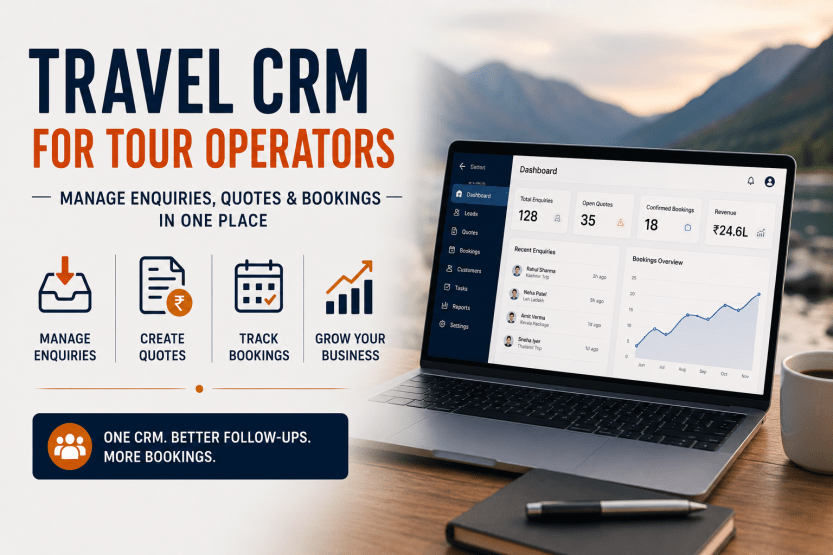
Ask any tour operator how they’re managing enquiries and you’ll usually get some version of the same answer: WhatsApp, a notebook, maybe an Excel sheet someone updates when they remember to. It works, until the day it doesn’t, until a ₹60,000 group booking enquiry sits unread for four days because it got buried under twenty other chats, and by the time someone replies, the client has already booked with a competitor who answered first.
That’s not a staffing problem. It’s a systems problem, and it’s the single most common reason tour operators lose bookings they should have won.
Why WhatsApp and Spreadsheets Stop Working
Both tools are fine at small scale. The trouble starts when enquiry volume grows past what one person can track in their head. Different team members reply to different channels with no shared visibility. A lead that came in through Instagram DM has no connection to the same client following up by email. Nobody quite knows who owns which enquiry, so either two people chase the same lead or nobody does.
None of this shows up as an obvious crisis. It shows up as a slow leak, a few lost bookings a month that quietly add up to a real revenue gap by year-end.
What a Travel CRM Actually Does Differently
A generic sales CRM assumes a fairly linear process: lead, call, proposal, close. Travel sales rarely work that way. A single enquiry might involve three destination options, two supplier quotes, a custom itinerary, and two weeks of back-and-forth before anyone commits. A travel CRM is built around that reality instead of fighting it.
| Without a CRM | With a Travel CRM |
|---|---|
| Enquiries scattered across WhatsApp, email, Instagram | Every enquiry lands in one shared pipeline |
| Quotations built from scratch in Word every time | Itinerary templates generate quotes in minutes |
| Follow-up depends on someone remembering | Automated reminders keep leads warm |
| No idea which channel actually converts | Clear data on source, conversion rate, and team performance |
The Features That Actually Matter
Centralized lead capture. Website forms, Meta lead ads, and WhatsApp Business API should all funnel into one dashboard automatically. If your team is still copy-pasting enquiries between apps, you’re already losing time you don’t need to.
Lead qualification before your team wastes time on it. Not every enquiry is a real one. Conditional logic on your lead forms, asking group size and travel dates upfront, filters out casual browsers before a salesperson spends an hour on a quote nobody wanted.
Itinerary and quotation tools. Manually formatting a fresh itinerary document for every single enquiry is the single biggest time sink in most small travel businesses. Templates fix this in minutes, not hours.
Supplier and vendor tracking. Hotels, transport, guides, all coordinated in one place instead of scattered across someone’s phone contacts and memory.
Conversion reporting. Which lead source actually converts? Which team member closes the most bookings? Without data, these are just opinions. With a CRM, they’re answers.
A Realistic Before-and-After
Before: enquiry arrives, gets noted somewhere (or nowhere), gets answered whenever someone has time, quotation takes an hour to build from scratch, follow-up happens if someone remembers.
After: enquiry is auto-captured and assigned, qualification filters out the non-serious leads immediately, a quotation goes out in minutes using a template, an automated reminder brings the lead back to someone’s attention three days later if there’s been no response, and the whole thing shows up in a report at the end of the month.
Same team, same enquiry volume, meaningfully fewer leads falling through the cracks.
Signs You’ve Already Outgrown Your Current System
- Your enquiry management runs primarily on WhatsApp and personal memory
- Team members have no visibility into what colleagues are handling
- You regularly discover a lead that was never followed up on
- Quotations take an hour or more to put together each time
- You genuinely couldn’t say which marketing channel drives the most bookings
If two or more of these sound familiar, the cost of not having a CRM is very likely already higher than the cost of getting one.
Quick Answers
Isn’t a travel CRM just a fancier version of Zoho or HubSpot?
Not really. Generic CRMs need heavy customization to handle itineraries, group bookings, and supplier coordination. A travel-specific system already understands this workflow without the workaround.
Is this only useful for large DMCs?
Smaller operators often benefit more, since one missed enquiry represents a bigger share of their monthly revenue than it would for a large agency.
Does it work with WhatsApp?
Modern travel CRMs built for the Indian market typically integrate with WhatsApp Business API, so conversations get tracked in the CRM instead of living only on someone’s phone.
How long does setup actually take?
For a single operator, basic setup with lead capture and itinerary templates usually takes a few weeks, depending on how much your process needs to be customized.
If your booking volume is growing but your enquiry process still runs on WhatsApp and memory, the CRM isn’t a nice-to-have. It’s the missing infrastructure deciding how many of your leads actually become paying clients.
We build travel CRM and technology solutions designed around how DMCs and tour operators actually sell, not around a generic sales pipeline. Talk to our team about your current enquiry process, or read our guide on what a lead-generating business website actually needs if your website itself is part of the problem.