
Most business websites in India look fine. That’s the problem. They look fine, load slowly, say nothing specific, and quietly cost their owners enquiries every single day, and nobody notices it happening. A visitor lands, skims for three seconds, doesn’t find what they need fast enough, and leaves. No error message, no complaint. Just gone.
If your website was built primarily to “look professional,” it’s probably doing that job well and almost nothing else. Here’s what actually separates a website that generates leads from one that just sits there.
Why “It Looks Good” Isn’t Enough
A website is judged in about the same time it takes to read this sentence. In that window, a visitor decides three things: is this relevant to me, do these people know what they’re doing, and what am I supposed to do next. Miss any one of those and the visit is over before it started.
The businesses that get this wrong usually built their site around how they wanted to describe themselves, not around what a customer searching for their service actually needs to see first. That mismatch is invisible to the business owner and completely obvious to everyone else.
What Actually Moves the Needle
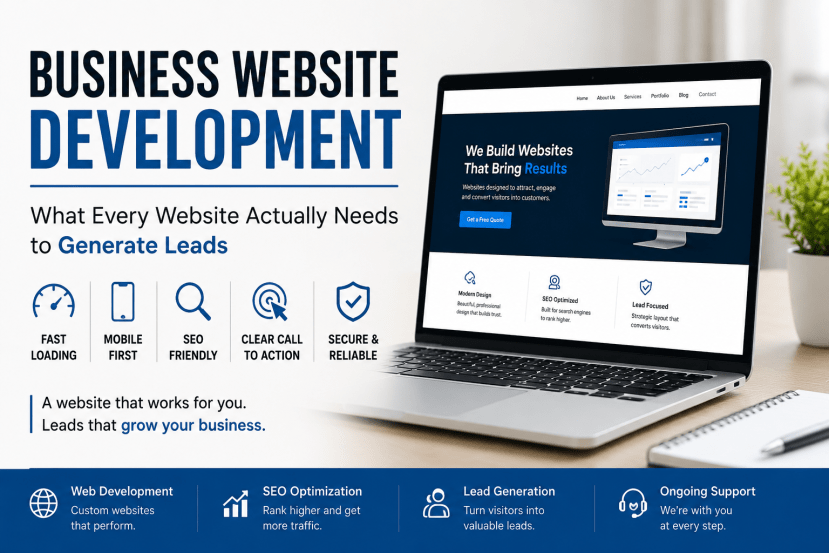
Speed. Not “fast enough,” actually fast. Every extra second before a page loads pushes more people back to Google. Bloated page builders and uncompressed images are the usual culprits, and they’re avoidable with clean, custom-built code instead of a stacked theme with a dozen plugins fighting each other.
Mobile first, not mobile-friendly. There’s a real difference between a site that technically resizes on a phone and one that was actually designed for a thumb and a small screen from the start. Most Indian search traffic is mobile now. If your site was designed on a widescreen monitor and shrunk down afterward, it shows.
A structure search engines can actually read. This is where our SEO-friendly website design work usually starts, clean headings, sensible URLs, no orphaned pages Google can’t find a path to. You can bolt SEO onto a badly structured site later, but it costs more and works worse than building it in from day one.
One clear next step per page. Not five competing buttons. Pick the one action you want, “Get a Quote,” “Start a Project,” whatever fits, and make it impossible to miss on every page, not just the homepage.
Navigation: The Part Nobody Thinks About Until It’s a Mess
A cluttered menu with a dozen items does the same thing a cluttered store shelf does, it makes people hesitate, and hesitation is where you lose them. If you offer several distinct services (say, web development, CRM software, and SEO), grouping those under clear categories in the nav, rather than a flat list of fifteen links, lets visitors self-sort into the right page in one click instead of three.
Rule of thumb: if a genuinely important page is more than two clicks from your homepage, most visitors will never find it.
Different Website Types Need Different Things
| Website Type | Primary Job | What It Needs Most |
|---|---|---|
| Business website | Establish credibility, generate enquiries | Clear service pages, testimonials, fast load |
| Corporate website | Represent the brand at scale | Structured navigation across departments |
| Ecommerce store | Convert browsers into buyers | Simple checkout, minimal steps to purchase |
| Landing page | One campaign, one goal | Zero distractions, single CTA, no full nav |
| Custom web application | Automate a specific business process | Built around your actual workflow, not a generic template |
We cover the differences in more depth in our upcoming guide on custom web applications vs off-the-shelf software, if you’re trying to figure out which category your project actually falls into.
Trust Signals: Why Two Good Testimonials Beat Ten Generic Ones
“Great to work with, highly recommend” tells a visitor nothing. A testimonial that names the actual problem and the actual result, specifics, not adjectives, does the convincing work that vague praise never will. Put those near the relevant service section, not buried on a single “Testimonials” page nobody visits.
Same goes for basic credibility markers people scan for without realizing it: a real phone number, a real address, clear information about how you actually work and price. Missing these doesn’t necessarily scream “untrustworthy,” it just quietly raises doubt, and doubt kills conversions.
A Website Development Process That Doesn’t Skip the Boring Parts
- Discovery, actually understanding the business and its goals before opening a design tool
- Planning, mapping the structure and user journey, not just the visual look
- Design, building interfaces around your brand, not a generic template
- Development, clean, secure, responsive code
- Testing, real devices, real connection speeds, not just a resized browser window
- Launch and support, because a website isn’t done the day it goes live
Skip discovery and planning, and you’ll end up with something that looks polished in a screenshot and underperforms in reality. This is the step most rushed projects cut, and it’s usually the reason they need a redesign within two years.
What Happens After Launch (The Part Everyone Forgets)
A website isn’t a one-time purchase. Search engines notice stale content. Visitors notice broken links and expired offers still sitting on the homepage. And an unmaintained site becomes a slowly growing security risk, not a dramatic one, just a quiet, compounding one that eventually costs more to fix than it would have to prevent.
Budget for maintenance from the start. It’s cheaper than the alternative.
Quick Answers
How much does a business website cost in India?
Depends entirely on scope, pages, features, integrations. Anyone quoting a flat number before understanding your actual requirements is guessing.
How long does it take?
Most standard business sites: a few weeks. Ecommerce or custom applications: longer, depending on complexity.
Can I update the content myself later?
If it’s built with a proper CMS or admin panel, yes, without calling a developer every time you need to change a sentence.
Is SEO included, or is that separate?
It should be built in from the start, clean code, proper structure, fast load times, not treated as an add-on project six months later.
A business website that generates leads isn’t the prettiest one. It’s the one built around how your actual customers search, decide, and act, fast, mobile-first, structured for search engines, and clear about what to do next on every single page.
We build business websites, corporate sites, and custom web applications around exactly that. Start a project with us, or explore our full Web Development services.